Sustainable art is not one medium, movement or visual style. It may be dramatic or restrained, figurative or abstract, permanent or deliberately temporary. It may show damaged landscapes, but it may also occupy a domestic room without any immediately recognisable ecological symbol. The term is most useful when it opens enquiry rather than closes it.
At least six dimensions can be distinguished. The first is subject: work may examine climate, extraction, biodiversity, pollution, land, consumption or human relationships with the natural world. The second is material: an artist may use reclaimed, recycled, responsibly sourced, regenerative or pollution-remediating matter. The third is process: waste, toxicity, water, energy, fabrication and labour may be actively reconsidered. The fourth is presentation and movement: scale, modularity, packaging, transport and exhibition affect the work beyond the studio. The fifth is longevity and afterlife: repair, change, reuse, re-performance or responsible retirement may be designed into the work. The sixth is social and cultural relationship: collaboration, consent, fair work, local knowledge and access belong within environmental responsibility rather than outside it.
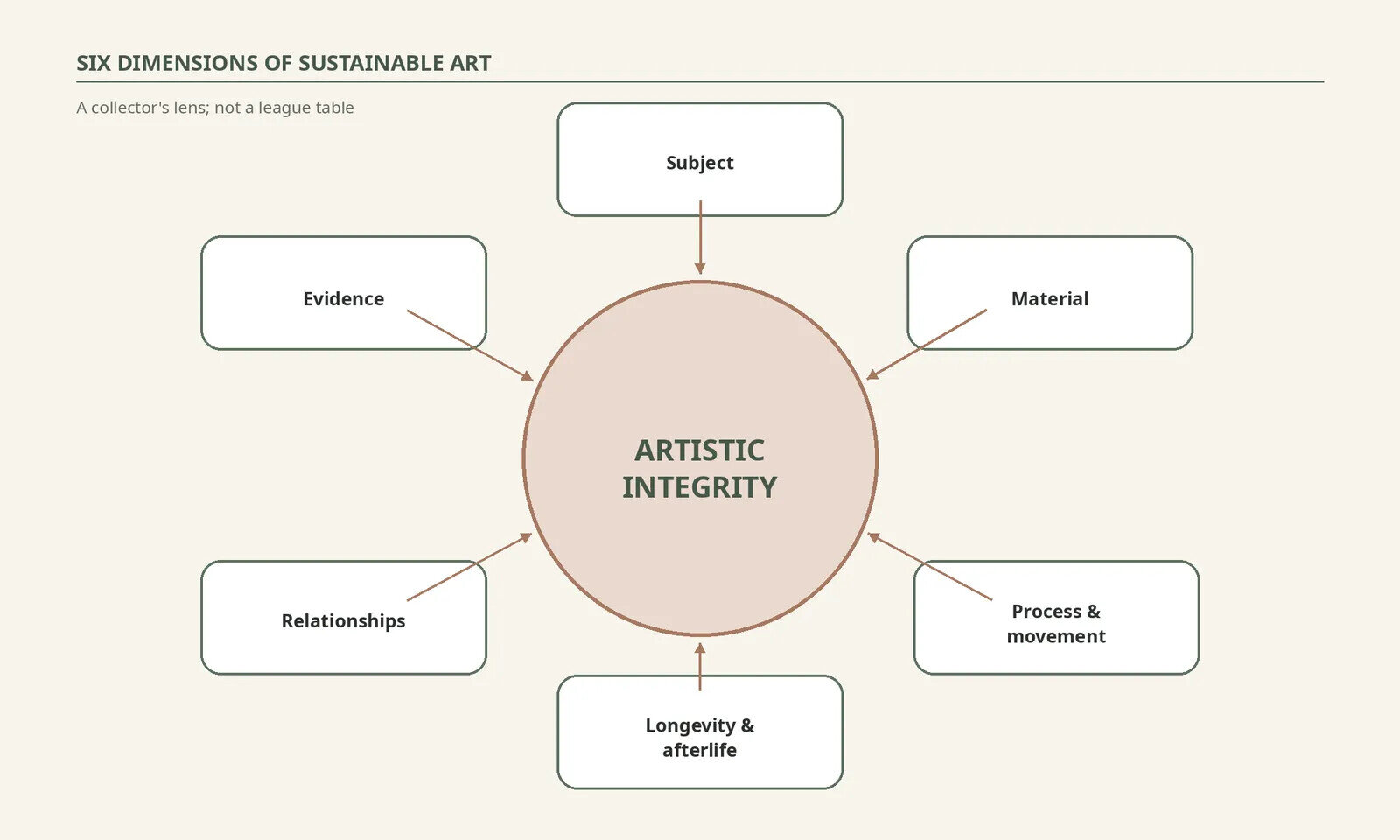
These dimensions overlap, but none should be treated as proof of all the others. A painting of threatened water may be made with conventional materials. A sculpture that absorbs an airborne pollutant may require an energy-intensive fabrication process. A work made from reclaimed matter may contain an adhesive that prevents future separation. A ceramic piece may require firing but endure for centuries. A collector should resist both easy praise and easy condemnation. The point is to understand the configuration of decisions that belongs to this particular work.
Environmental subject is not environmental performance
Collectors should distinguish the meaning of a work from the conditions of its production. An artwork can contribute powerfully to ecological culture even when its materials are not exemplary. Art changes attention, language and public imagination; these are real forms of influence. But an urgent subject should not make practical impacts invisible. Conversely, a materially responsible practice should not be forced to adopt overt environmental imagery in order to qualify.
This distinction prevents sustainable art from becoming an illustrative category. Artists need freedom to make complex, ambiguous and even uncomfortable work. A landscape does not need to behave like a campaign poster. A reclaimed material need not retain a visibly rough or virtuous appearance. Environmental seriousness can be expressed through beauty, seduction, restraint, humour, unease or formal experiment. The collector’s task is to ask whether the means and meaning are coherent, not whether the work resembles a pre-existing image of sustainability.
Responsibility rather than purity
No material artwork has zero impact. Even a found object has a history and may need cleaning, fixing, lighting, transport or storage. Digital and performance practices depend on devices, travel, energy, data and documentation. Natural materials can be toxic, overharvested or short-lived. Synthetic materials can be durable, structurally efficient and used in small quantities. Reclaimed matter can carry contamination or require considerable processing. The language of purity therefore produces more confusion than progress.
Responsibility is a more credible standard. It asks whether relevant information was sought, avoidable harm was reduced, trade-offs were considered and the result was documented honestly. It also asks what was proportionate. A rarely used specialist material may be less significant than repeated air freight, a poorly loaded kiln or an artwork that fails prematurely. The collector does not need a complete life-cycle assessment for every acquisition. They need enough understanding to recognise material questions that could affect meaning, care, risk or the truth of a public claim.
A Question Worth Asking
If the environmental explanation were removed, would the artwork still hold your attention? If the answer is uncertain, the next question may be artistic rather than environmental.
Sustainable art as an evolving field
Materials, methods and knowledge change. A claim that was reasonable when a work was made may later require qualification. A new recycling route may become available; a supplier may alter a formulation; a material promoted as compostable may prove unsuitable for the conditions in which it is used. A collector should expect a serious practice to contain learning and uncertainty.
This does not weaken confidence. Confidence grows when an artist and gallery can explain what is known, identify the boundaries of the claim and retain the records that support it. Sustainable art is not a fixed category awarded once. It is an evolving relationship between artistic intention, material fact and responsible stewardship.

Frequently Asked Questions
What is sustainable art?
Sustainable art considers environmental and social responsibility through one or more dimensions of subject, material, process, movement, longevity and relationships, while remaining grounded in artistic integrity.
Does sustainable art have a single visual style?
No. Sustainable art may be abstract or figurative, dramatic or restrained, permanent or temporary. Its environmental seriousness does not depend on displaying familiar ecological imagery.
Can an artwork have zero environmental impact?
No material artwork is impact-free. A credible assessment considers proportion, evidence, durability and trade-offs rather than claiming purity.
Continue exploring
The Collector’s Guide to Sustainable Art
This guide forms part of Sustainable Art’s independent, evidence-led library for artists, collectors and readers.